Battery life for electric forklifts is usually not measured in “hours” but in “one shift”. Ideally, a single battery should be able to support a full 8-hour shift.
Typical Range: Under standard workload conditions (not 24-hour full load), a fully charged electric forklift can usually work continuously for 6 to 10 hours.
Key Influencing Factors
Battery Capacity: Expressed in voltage (V) and ampere-hours (Ah), such as 48V/500Ah. The larger the capacity, the longer the battery life.
Work Intensity: Frequent lifting, traveling, climbing slopes, and transporting heavy loads will quickly consume power. There is a huge difference in power consumption between transporting 1-ton and 3-ton goods.
Operating Habits: Sudden acceleration and sudden braking will significantly increase power consumption.
Working Environment: In low-temperature environments, battery performance will decrease and battery life will be shortened; driving on flat and smooth ground is more energy-efficient than on bumpy ground.
Simple Estimation Method
Total Battery Energy (kilowatt-hours, kWh) ≈ Voltage (V) × Ampere-hours (Ah) ÷ 1000
For example: A 48V/500Ah battery ≈ 24 kWh.
Assuming the forklift consumes an average of 3-4 kWh per hour, the battery life is approximately 6-8 hours.
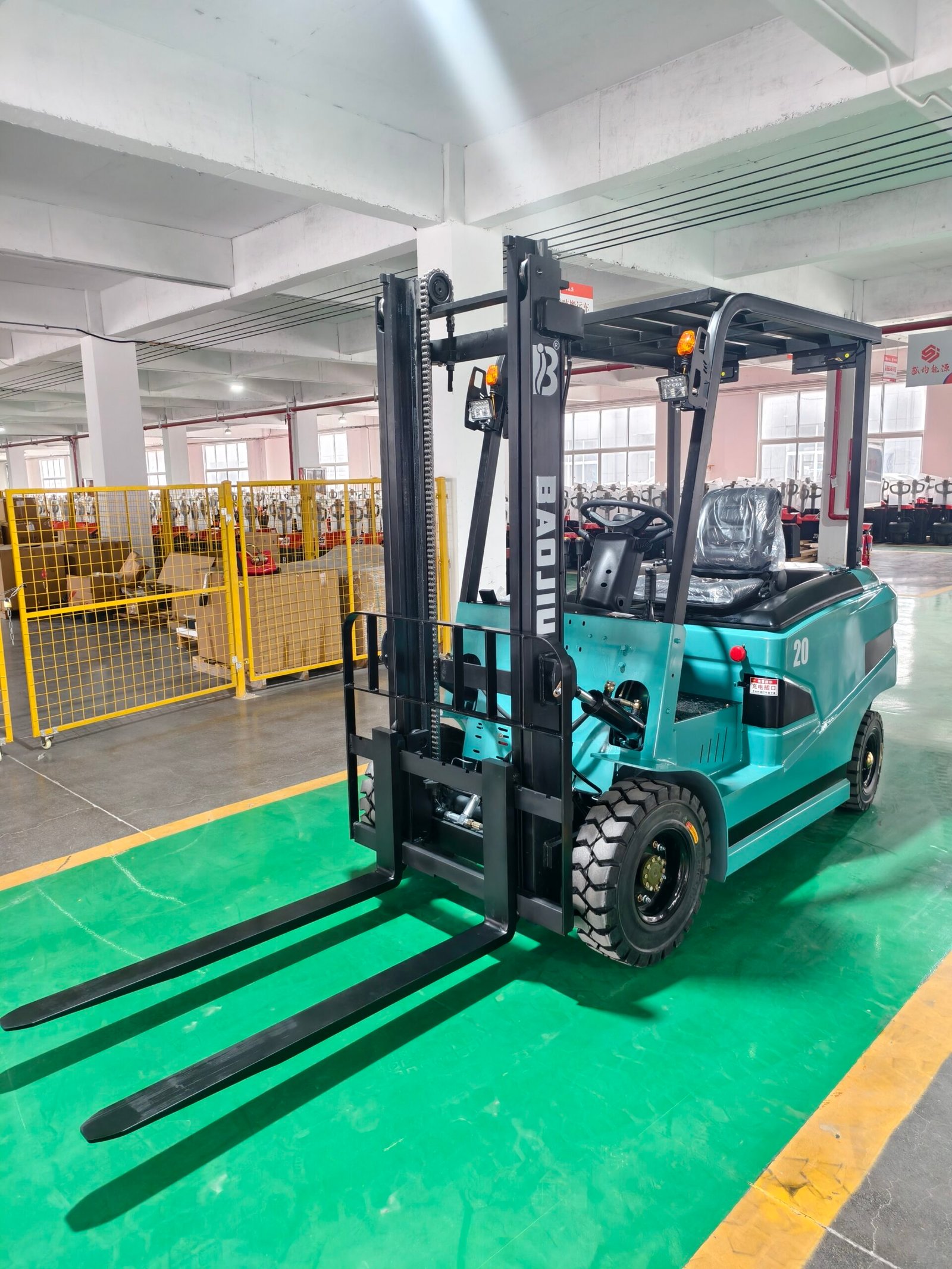
In summary, understanding electric forklift runtime and its influencing factors helps optimize operational arrangements. For reliable runtime performance tailored to your workload, our electric forklifts are engineered with high-quality batteries and efficient power management. Feel free to contact us for more customized solutions.